

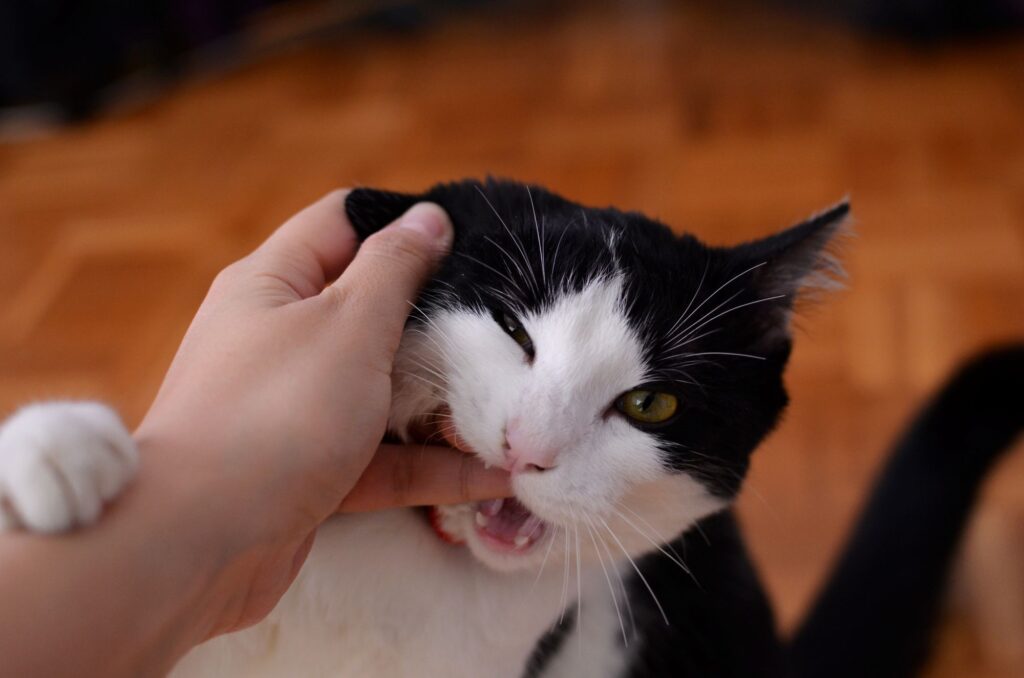
If you are asking “why does my cat bite me?”, the short answer is that most bites from a pet cat are communication, not malice. The usual reasons are overstimulation during patting (petting-induced aggression), rough play that treats your hands as prey, fear, frustration redirected at the nearest person, or pain. Each cause has its own fix, none of them involves punishment, and any sudden new biting deserves a vet check. If a bite breaks your skin, see a doctor, because cat bites become infected easily.
Why does my cat bite me? The five most common reasons
The Cornell Feline Health Center describes several distinct types of aggression in cats, including play aggression, petting-induced aggression, fear aggression, redirected aggression and pain-induced aggression. Working out which one you are dealing with is the first step, because the advice for a bored kitten ambushing your ankles is very different from the advice for an older cat who snaps when you touch her hips.
| Type of biting | What it usually looks like | Most likely trigger |
|---|---|---|
| Petting-induced (“love bites”) | A content cat on your lap suddenly bites your hand, then jumps down | Too much stroking, or stroking in the wrong spot |
| Play aggression | Stalking, pouncing and biting hands, feet or ankles, often in young cats | Pent-up energy and hands used as toys |
| Fear aggression | Hissing, crouching, ears flat, biting when cornered or handled | Visitors, vet visits, loud noises, being restrained |
| Redirected aggression | A cat staring out the window lashes out at whoever walks past | Something it cannot reach, such as a cat outside |
| Pain-related | Biting when a particular area is touched, or when picked up | Arthritis, dental disease, injury or other illness |
Petting-induced aggression: the “I was enjoying that, until I wasn’t” bite
This is the classic scenario: your cat climbs onto your lap, purrs, accepts a few strokes and then bites your hand and leaves. Cornell notes that the exact cause is unknown, with overstimulation and a cat’s wish to control when the interaction ends both suggested as explanations. VCA Animal Hospitals adds that stroking a cat enjoys at first can become unpleasant if it continues, and that some cats approach people for warmth, company, play or food rather than for patting at all.
What helps:
- Keep sessions short. A few strokes around the cheeks and chin, then stop while your cat is still relaxed.
- Let the cat ask. Cornell advises against uninvited handling. Offer a hand and let your cat rub against it rather than reaching over the top of them.
- Pair brief, light stroking with treats and lengthen sessions gradually, as Cornell suggests. VCA also describes using a consistent “all done” cue followed by a treat so the cat learns when contact will end.
- Stop at the first warning sign and give your cat space to calm down with no further contact.
- Supervise children. Cornell points out that young children often miss the early signals, so teach them to pat gently and briefly and to stop when the cat moves away.
Play aggression: why hands are not toys
Kittens and young cats are wired to stalk, chase and pounce. According to VCA Animal Hospitals, play-related aggression is linked to under-stimulation, excess energy and too few chances to play, and it can persist into adulthood, especially in cats under two years old with no feline companions. Cornell adds that kittens raised without littermates, or with few chances to play, may never learn that biting or scratching too hard ends the game.
Wrestling a kitten with your fingers feels harmless, but it teaches the kitten that skin is fair game, and those same bites hurt a lot more from a grown cat. Instead:
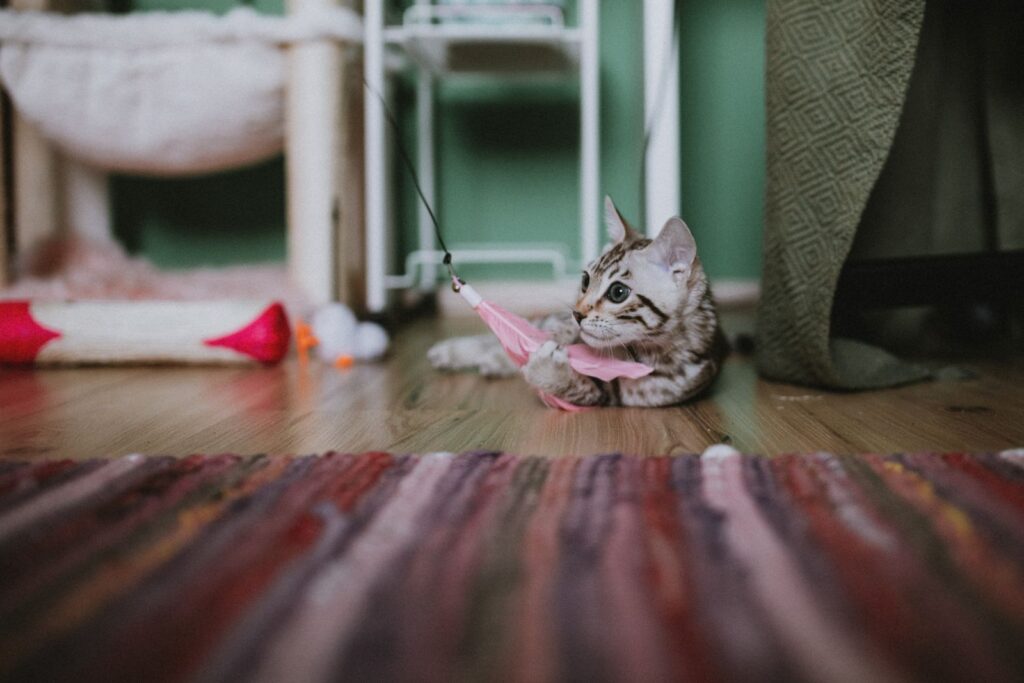
- Use toys that keep your hands at a distance. VCA lists wiggling ropes, wands and dangling toys as successful interactive toys. Hill’s Pet Nutrition Australia suggests tossing a toy across the room so your cat chases it instead of you.
- Schedule play. Several short, energetic sessions a day using wand toys burn off the energy that otherwise goes into ankle ambushes. Our guide to indoor cat enrichment has plenty of ideas for contained cats.
- End play before it boils over. VCA advises ending the session when you see side-to-side tail movement, ears going back or dilated pupils.
- Withdraw attention when teeth meet skin. VCA recommends ignoring the cat or walking out of the room so rough play earns no reward.
- Consider a playmate. For a very playful young cat, VCA notes that a second, well-socialised kitten can be a better wrestling partner than you.
Fear and redirected aggression
A frightened cat would usually rather hide than fight, but if it is cornered, picked up or restrained, it may bite. Cornell lists unfamiliar people, animals and noises, and past unpleasant experiences such as vet visits, as common triggers. Its advice is to identify and avoid situations that produce a fearful response, and where that is not possible, to expose the cat to the trigger gradually from a distance while rewarding calm behaviour.
Redirected aggression is more confusing for owners because the bite seems to come from nowhere. VCA Animal Hospitals explains that a cat aroused by something it cannot reach, such as another cat outside the window, may turn on a nearby person or pet. The safest response is to leave the cat alone until it calms down, which can take a while, and then deal with the trigger: blocking the view from a favourite window, for example, or discouraging roaming cats from your yard.
Pain is a common hidden cause
If a previously gentle cat starts biting, think about pain before behaviour. Cornell states that the first step in managing an aggressive cat is to make sure there is no medical reason, listing hyperthyroidism, osteoarthritis, dental disease and central nervous system problems among the possible causes. VCA notes that bites when a specific body area is touched may point to pain, and that dental, ear, joint, neck, back or skin problems can all make touch uncomfortable.
Older cats are especially good at hiding sore joints, so read our guide to signs of arthritis in cats if your senior cat has started objecting to being picked up or stroked along the back.
Reading the warning signs
Most cats give warnings before they bite. Cornell and VCA both describe dilated pupils, a lashing or flicking tail, ears turned back or flattened, and a tense or frozen body. If you can learn your own cat’s early signals, you can stop before the bite happens. Rather than repeat it here, we have a full guide to decoding your cat’s body language, including what tails, ears and slow blinks mean.
What to do when your cat bites, and what not to do
Do
- Go still, then calmly withdraw. Pulling sharply away can trigger more chasing. Gently disengage and step back.
- Give the cat space. VCA suggests walking away and waiting until you and your cat are both calm before interacting again.
- Redirect play bites to a toy before your hands become the target.
- Keep a simple diary of when bites happen, where you were touching and what was going on. Patterns make the cause much easier to spot.
- Book a vet check for any new, worsening or unexplained biting.
Do not
- Do not hit, flick, shout at or spray your cat. Cornell warns that any physical punishment can increase a cat’s fear or anxiety and make aggression worse. VCA notes that punishment creates fear, and that the cat was trying to communicate, even if a bite was the wrong way to do it.
- Do not touch or try to comfort an aroused cat. Cornell notes that physical contact during an episode can be read as play, and that consoling an aggressive cat may be perceived as approval.
- Do not keep patting through warning signs to “teach” your cat to tolerate it. This tends to make bites harder and faster.
When to see a vet
Call your vet if:
- biting is new, or has suddenly become more frequent or harder
- your cat bites when a particular part of its body is touched
- biting comes with other changes, such as hiding, reduced appetite, weight loss, limping, drooling or changes in grooming or litter tray habits
- you have an older cat whose temperament has changed
- aggression is severe, or anyone in the household is being injured
Cornell recommends consulting a veterinarian before trying to manage an aggressive cat with behavioural or environmental changes. Once medical causes are ruled out or treated, your vet may refer you to a veterinary behaviourist for a tailored plan.
Cat bites to people need prompt attention
Cat bites are easy to underestimate. Healthdirect Australia explains that cats’ small, sharp teeth can cause deep puncture wounds that can go right down to bone, and that up to 8 in 10 cat bites can become infected. Healthdirect’s advice is that if an animal bite has broken your skin, you should see your doctor as soon as possible. Go to the emergency department if the wound is large or deep, you were bitten on the face or head, or you cannot stop the bleeding.
For first aid on the way, Healthdirect suggests cleaning around the wound with soap and water, rinsing out any dirt or hair under running water, gently squeezing the wound so it bleeds a little, patting it dry and covering it with a clean dressing. Your doctor may prescribe antibiotics and will decide whether you need a tetanus booster. Even a small puncture can become infected, so watch for spreading redness, swelling, pus or fever.
Frequently asked questions
Are love bites a sign of affection?
Gentle nibbles that do not hurt can happen during grooming or relaxed contact. Bites that come after a period of patting, especially with a twitching tail or flattening ears, are usually a sign your cat has had enough. Treat them as a request to stop rather than as affection.
Why does my cat bite me and then lick me?
There is no single proven explanation. Grooming behaviour sometimes includes little nips, and some cats switch between licking and biting as they become overstimulated. Watch the body language around it: a relaxed cat is grooming, while a tense one is warning you.
Will my kitten grow out of biting?
Many kittens become gentler as they mature, but VCA notes that play aggression can persist into adulthood, particularly in cats under two with no feline companion. Consistently using toys instead of hands from day one is the best way to make sure it fades. If you have just brought a kitten home, our guide to kitten season in Australia covers the basics.
Should I squirt my cat with water when it bites?
No. Cornell warns that any physical punishment can increase fear and anxiety and worsen aggression. Stop the interaction, withdraw attention and redirect your cat to a toy instead.
Key takeaways
- Most cat bites are communication: overstimulation, play, fear, frustration or pain.
- Keep patting short and cat-led, and stop at the first warning sign.
- Never use hands or feet as toys. Use wand toys and throwable toys instead.
- Punishment makes biting worse. Withdraw, give space and redirect.
- New or sudden biting needs a vet check to rule out pain and illness.
- If a cat bite breaks your skin, clean it and see your doctor as soon as possible.
Sources
- Cornell Feline Health Center: Feline Behavior Problems: Aggression
- VCA Animal Hospitals: Cat Behavior Problems: Petting Aggression
- VCA Animal Hospitals: Play and Predatory Aggression in Cats
- VCA Animal Hospitals: Cat Behavior Problems: Aggression Redirected
- Hill’s Pet Nutrition Australia: When Does Play Aggression in Cats Cross the Line?
- Healthdirect Australia: Dog, cat, bat and human bites
This article is general information only and is not a substitute for advice from a registered veterinarian who has examined your cat. If you have been bitten and the skin is broken, seek medical advice from your doctor.