
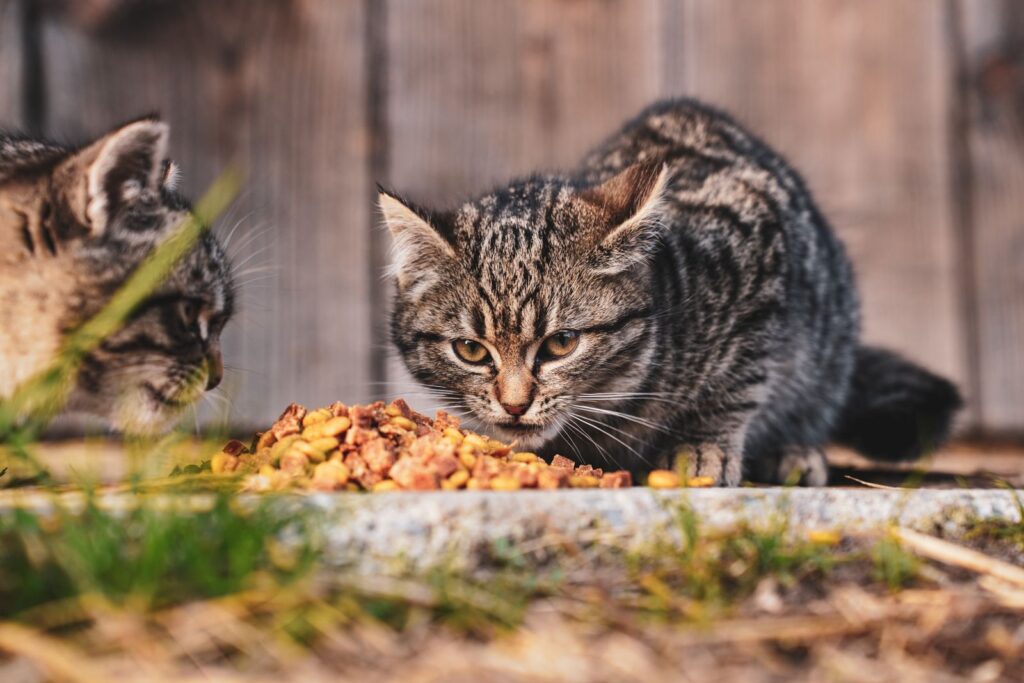
How much to feed a kitten depends on its age, weight and the calorie density of the food, so the most reliable starting point is the feeding guide on a complete and balanced kitten food, adjusted up or down according to your kitten’s body condition. As for how often: RSPCA Australia advises offering food at least four times a day to young kittens, and most kittens move gradually to two or three meals a day as they approach adulthood, switching to adult food at around 12 months.
Kitten feeding at a glance
Vets and welfare groups don’t all use the same schedule, so treat this table as a guide. Sources for each stage are in the sections below.
| Age | What they eat | Meals per day |
|---|---|---|
| 3 to 4.5 weeks | Nursing from mum (orphans need a kitten formula), plus first tastes of a smooth kitten food gruel | Nursing on demand, gruel offered several times a day |
| 4.5 to 8 weeks | Moistened kitten food, moving to canned and/or dry kitten food on its own | Several small meals; fresh water always available |
| 8 to 12 weeks | Complete and balanced kitten food, wet with some dry | At least 4 |
| 3 to 6 months | Complete and balanced kitten food | 3 to 4 (some vets drop to 2 from about 12 to 14 weeks) |
| 6 to 12 months | Complete and balanced kitten food | 2 to 3 |
| Around 12 months | Gradual change to complete and balanced adult food (later for some large breeds) | 1 to 2, or portioned feeds spread through the day |
Weaning: around 3 to 8 weeks
Kittens raised by their mother start showing interest in solid food at around four weeks, according to a weaning handout from Maddie’s Fund, a US shelter medicine organisation. Orphaned kittens are usually started a little earlier, at about three weeks. The handout describes a typical progression:
- 3 to 4.5 weeks: a thick gruel, roughly the consistency of porridge, made from a smooth canned kitten food mixed with water. Formula in the gruel is best kept for bottle-fed orphans whose stomachs are used to it.
- 4.5 to 6 weeks: dry kitten food soaked until mushy.
- 6 to 8 weeks: most kittens are eating canned and/or dry food on their own and drinking water from a bowl.
The same handout stresses that water intake must rise as nursing tapers off, so put a shallow bowl of fresh water down as soon as weaning starts. RSPCA Australia notes that kittens naturally finish weaning at around 8 to 12 weeks of age.
Orphaned kittens need a proper kitten formula and a prompt vet check. Our guide to whether cats can drink milk explains why the dairy in your fridge is not the answer.
8 to 12 weeks: the new kitten at home
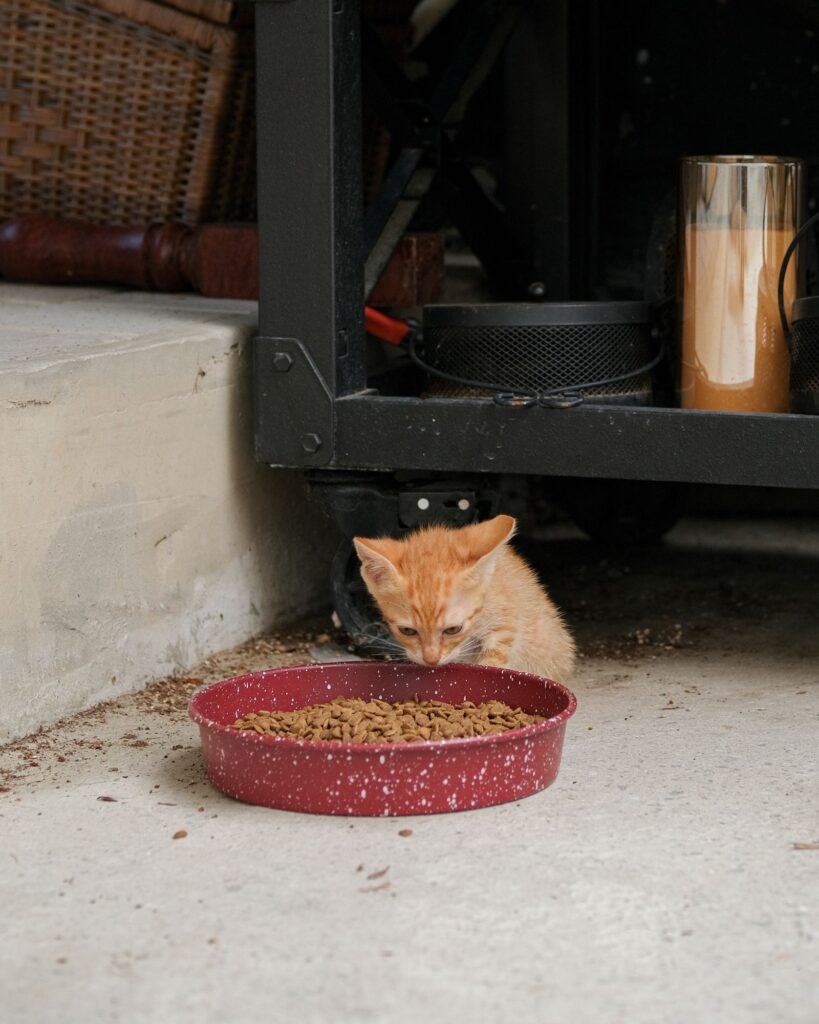
Many kittens go to their new homes in this window. RSPCA Australia recommends offering kittens food at least four times per day, with fresh drinking water available at all times.
For the first week or two, stick with whatever the breeder or shelter was using, even if you plan to change brands. A new home is stressful enough, and the Maddie’s Fund handout notes that avoiding diet changes helps prevent digestive upset and food refusal.
3 to 6 months: rapid development
This is a period of rapid development, and also when many kittens are desexed. Advice on meal frequency starts to vary here. Greencross Vets suggests three meals a day up to about 12 to 14 weeks and two meals a day after that, while noting there is no definite rule. RSPCA NSW suggests three meals a day for weaned kittens until around 10 months.
In practice, three or four portioned feeds suit most kittens at this age. Greencross also notes that some kittens like to graze through the day, which is fine as long as the daily ration is controlled so the kitten doesn’t become overweight. Measuring the full day’s food each morning makes this easy.
6 to 12 months: slowing down
By the second half of the first year your kitten is closer to adult size, and unlimited food can start to show up as extra padding, so keep checking body condition. Most kittens do well on two or three meals a day, and RSPCA NSW suggests once or twice a day from around 10 months to keep a healthy weight. Stay on a kitten formula until it is time to change over.
Wet, dry or both?
Either can be complete on its own. RSPCA Australia suggests it is best to start with wet kitten food and introduce dry kitten food as your kitten grows, with moist food offered regularly. Greencross notes that many kittens do well on mixed feeding.
The catch with mixing is the maths. Feeding guides on packs assume that product is the only thing your kitten eats, so if you feed wet and dry together, you need to reduce the amount of each. A simple approach is to decide what share of the day each will provide (for example, half wet and half dry) and feed that share of each pack’s recommended daily amount.
Choose a complete and balanced kitten diet
Kittens need more of several nutrients than adult cats. VCA Animal Hospitals explains that the AAFCO nutrient standards for growth require higher minimum protein and vitamin A levels and different mineral amounts compared with adult maintenance diets. Look for a food labelled “complete and balanced” for growth or for all life stages.
In Australia, RSPCA Australia advises that foods offered to kittens should meet the Australian Standard for the manufacturing and marketing of pet food (AS 5812). Our guide to reading a pet food label walks through what the label statements mean.
Two foods to avoid as a main diet:
- Dog or puppy food. RSPCA Australia warns it will be deficient in taurine, an essential nutrient cats must get from their food.
- Raw diets and bones. RSPCA Australia does not recommend them for kittens because they can carry bacteria that make both pets and people ill. If you are considering that route, read our article on cats and raw chicken first.
How to work out the right amount
Because products differ so much in calorie density, there is no single “grams per day” figure that applies to every kitten. Use this three-step approach:
- Start with the label. Find your kitten’s age and current weight on the pack’s feeding guide and use that daily amount, split into meals.
- Check weight regularly. Kittens should gain weight steadily. Kitchen scales work for small kittens, and your vet clinic will usually let you pop in to use theirs.
- Fine-tune by body condition. Body condition is a hands-on check of fat cover. On the 9-point scale described by the Cornell Feline Health Center, 5 is ideal. Ask your vet to show you how to check it at home. If your kitten sits under ideal, offer a little more; if over, offer a little less.
RSPCA Australia notes that your vet can check your kitten’s weight, assess its body condition and advise on amounts, so use vaccination visits as a feeding check-in too.
Water, treats and dairy
- Water: clean, fresh water should be available at all times.
- Treats: the Cornell Feline Health Center suggests treats should not exceed 10 to 15 percent of a cat’s daily calories. For a small kitten that is not much, so count treats as part of the daily ration or use a few pieces of their own kibble.
- Dairy: RSPCA Australia advises against giving milk to kittens because it can cause gastrointestinal upsets.
Desexing changes appetite
Most kittens are desexed well before they reach adult size. The University of Sydney Veterinary Teaching Hospital notes that for most kittens, planning desexing by four months of age is sensible. Our article on what happens when your pet is desexed covers the surgery and recovery.
From a feeding point of view, the key change is appetite. In a study of adult male cats published in PLOS ONE, cats given free access to food after neutering ate more and gained weight, mainly as fat, and the researchers concluded that food intake should be controlled after neutering to prevent weight gain. In practice, that means switching from free feeding to set portions around desexing time and watching body condition closely over the following months.
When to switch to adult food
Most kittens can move to adult food at around 12 months. VCA notes that most kitten food packs are intended for cats up to one year, that your vet may recommend switching sooner or later, and that large breeds such as Maine Coons often stay on kitten food for longer.
Change foods gradually over about two weeks. Greencross suggests roughly 20 percent new food for days 1 to 4, 40 percent for days 5 to 7, 60 percent for days 8 to 10 and 80 percent for days 11 to 13, before moving fully to the new diet.
Frequently asked questions
How much should a 10-week-old kitten eat?
Use the feeding guide for your kitten’s weight on a complete and balanced kitten food, divided into at least four meals a day, then fine-tune by weight gain and body condition. Amounts vary a lot between brands, so there is no single correct figure.
Can I leave dry food out all day for my kitten?
Grazing can work if you portion out the day’s ration once and don’t keep topping it up. Once your kitten is desexed, set portions make weight control easier.
My kitten always seems hungry. Should I feed more?
Judge by body condition and weight gain, not begging. If your kitten is thin, stops gaining weight, or is eating a lot but losing weight, see your vet.
Key takeaways
- Start with the pack guide on a complete and balanced kitten diet that meets AS 5812, then fine-tune by body condition.
- Young kittens need at least four small meals a day, tapering to two or three by six to twelve months.
- If you mix wet and dry food, cut back each so the day’s ration stays right.
- No dairy and no dog food, and RSPCA Australia does not recommend uncooked diets or bones.
- Control portions after desexing and switch gradually to adult food at around 12 months.
Sources
- RSPCA Australia Knowledgebase: What should I feed my kitten?
- RSPCA NSW: Caring for cats and kittens
- Greencross Vets: Kitten feeding guide: nutrition, portions and frequency
- Maddie’s Fund: Transitioning kittens and puppies to solid food
- VCA Animal Hospitals: Your guide to kitten nutrition
- Cornell Feline Health Center: Feeding your cat
- University of Sydney Veterinary Teaching Hospital: New kitten care
- PLOS ONE: Early effects of neutering on energy expenditure in adult male cats (Wei et al., 2014)
This article is general information for Australian cat owners and is not a substitute for advice from a registered veterinarian. Kittens with health conditions, very small or orphaned kittens, and large breeds may need a tailored feeding plan, so ask your vet.


