To stop a dog pulling on the lead, make pulling stop working and make walking beside you pay off. Every time the lead goes tight, stand still; the moment it goes slack, move forward again, and reward your dog often with small treats when it is close to your leg. Start somewhere boring like your backyard, use a well-fitted harness rather than a choke chain or prong collar, and practise in short, frequent sessions. Consistency from everyone in the household matters more than any gadget.
Late spring is when Aussie walks get longer and parks get busier, which is exactly when a strong puller becomes a sore shoulder. Here is a step-by-step plan that works for puppies and adult dogs alike.
Why dogs pull on the lead
Dogs aren’t being stubborn or “dominant” when they pull. Walking politely on a lead is a learned skill, not something dogs know by default, and the American Kennel Club recommends teaching it from the day a puppy comes home. A few things work against us:
- Pulling gets results. If straining forward gets your dog to the next smell, pulling has been rewarded. That is why RSPCA Queensland advises owners to stop when their dog pulls, so the dog isn’t rewarded for it.
- The world is exciting. Smells, people, birds and other dogs are far more interesting than the person at the other end of the lead, unless that person is worth paying attention to.
- Inconsistent rules. If pulling works on Monday with one person and not on Tuesday with another, the dog learns that pulling sometimes pays, which keeps it going.
The good news is that the same learning process can be turned around.
Reward-based loose-lead walking, step by step
The RSPCA describes reward-based training as setting a dog up to succeed and then rewarding the behaviour you want, and calls it the most humane and effective way to train dogs. Loose-lead walking is a textbook example.
Step 1: Pick your rewards and your spot
Use small, soft, tasty treats, such as tiny pieces of cooked chicken or cheese, which RSPCA Queensland suggests so your dog stays focused without filling up. Start in your backyard, a hallway or a quiet driveway, where there is very little to compete with you.
Step 2: Reward the position you want
Decide which side you want your dog on and keep your treats in that hand. Every time your dog is beside your leg with a loose lead, mark it with a quick “yes” and hand over a treat right there, next to your leg. The AKC recommends rewarding check-ins and eye contact on lead, and then rewarding your dog for staying near your side as you move. At first you will be rewarding every step or two. That is normal, and you will gradually space rewards out.
Step 3: Stop and wait when the lead goes tight
The moment the lead tightens, stop walking and stand still like a tree. Don’t jerk, yank or repeat commands. Wait until your dog eases back or turns to look at you and the lead goes slack, then praise and move forward again. RSPCA Queensland puts it simply: a loose lead means your dog can walk, and a tight lead means stop. In the first sessions you may only get a few metres. Persist, because this is where your dog learns that pulling never gets them anywhere.
Step 4: Change direction
If your dog keeps charging ahead, turn around cheerfully and walk the other way. Say your dog’s name or a cue such as “this way” just before you turn, and reward when they catch up with you. The AKC suggests using cues like “let’s go” and “turn” and rewarding your dog for staying with you through the turn. Direction changes keep your dog paying attention to where you are going rather than just the horizon.
Step 5: Add distance, then distractions
Only when your dog is walking nicely in the yard should you move to the front footpath, then a quiet street, then a busier park. Each new place is harder, so expect to go back to rewarding more often for a while.
Choosing equipment
Equipment won’t teach loose-lead walking on its own, but the right gear makes training safer and more comfortable.
| Equipment | Notes |
|---|---|
| Flat collar | Fine for carrying ID and for dogs that already walk well. For strong pullers, pressure on the neck is a reason many trainers prefer a harness. |
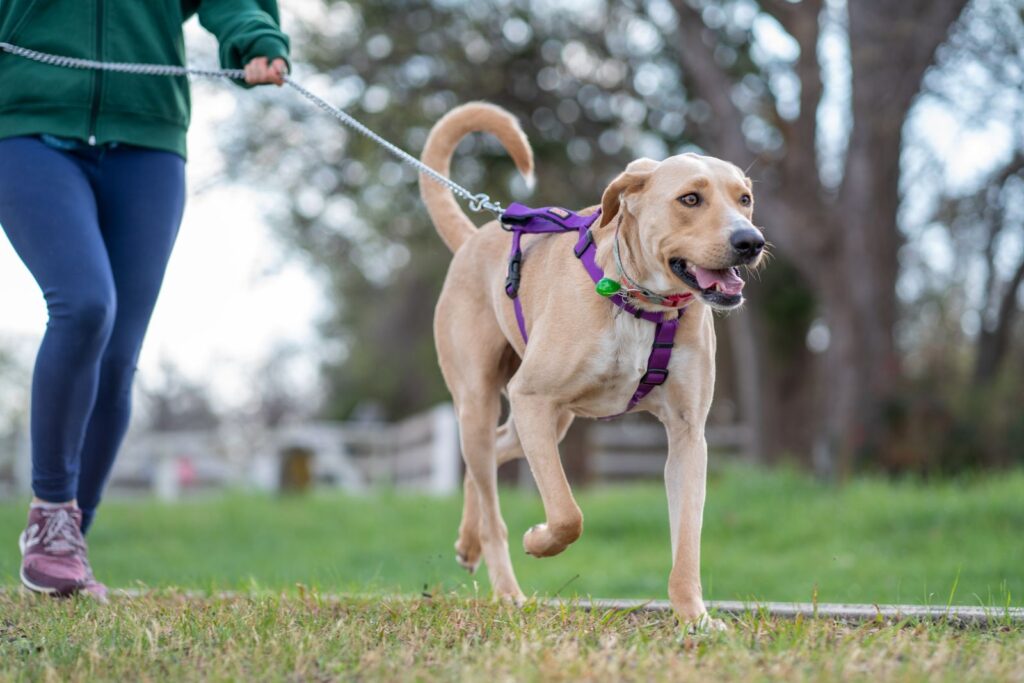
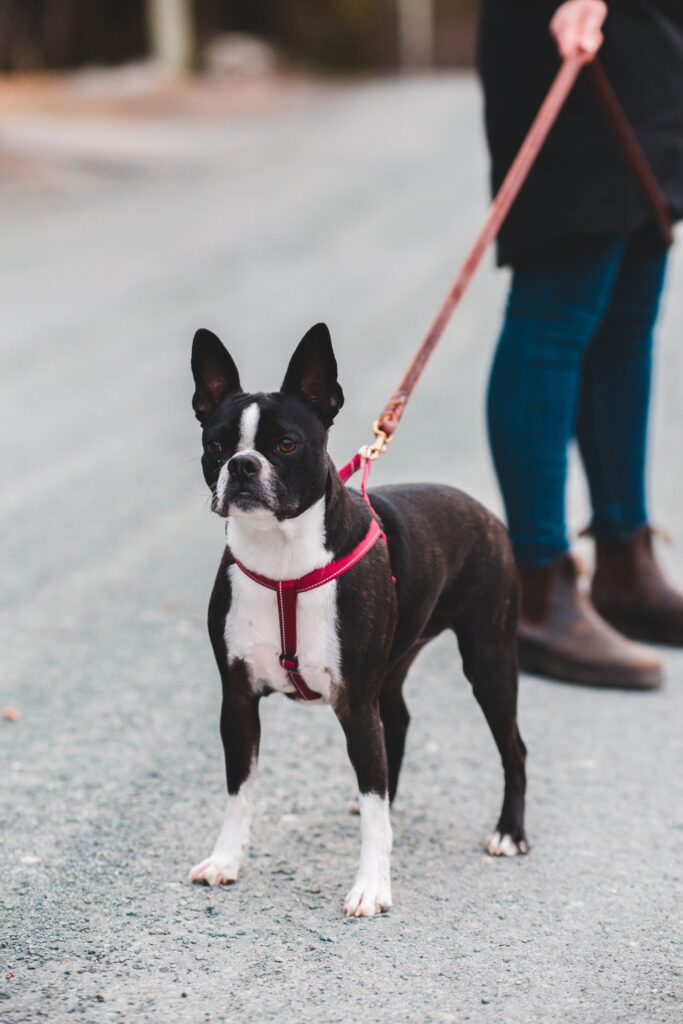
| Front-clip harness | RSPCA Queensland recommends a front-attaching harness, used with a double-ended lead, fitted securely and comfortably. The AKC also suggests a front-clip style for larger puppies. |
| Head halter | Some trainers use these for very strong dogs, but RSPCA Queensland cautions that head collars can cause injury or discomfort if used inappropriately. If you try one, get advice on fitting and introduce it slowly with treats. |
| Retractable lead | Not recommended for training. RSPCA Queensland notes extendable leads teach dogs to pull, because the lead lets them get further away when they push into it. |
| Choke (check) chains and prong collars | Not recommended. See below. |
Why choke chains and prong collars are not the answer
Aversive tools work by making pulling uncomfortable or painful. Australian vets and animal welfare groups advise against them.
- The Australian Veterinary Association policy states that punishment and negative reinforcement should not be used to change dogs’ behaviour, and that training is best achieved through positive reinforcement. The policy also notes that inappropriate use of a choker chain can lead dogs to pull more.
- RSPCA Australia opposes pronged or pinch collars, explaining that they work by inflicting pain, which it links to stress, fear, aggression and physical injury.
- RSPCA Queensland says it does not encourage check chains, shock collars or citronella collars because they rely on fear and distress.
- Prong collars are illegal to import into Australia, and their use on dogs is banned in Victoria, Tasmania and Queensland, according to the RSPCA.
The research backs this up. A 2017 review in the Journal of Veterinary Behavior concluded that aversive methods can jeopardise both the physical and mental health of dogs, and found no evidence that they are more effective than reward-based training.
Managing distractions
Most pulling happens when something exciting appears: another dog, a bird, a person with food, a great smell. A few practical habits help:
- Increase distance. Cross the road or step onto a driveway so your dog can still think and take treats.
- Upgrade your rewards when the environment gets harder. The AKC recommends higher-value treats as you add distractions.
- Use sniffing as a reward. Let your dog go and sniff that interesting tree as a reward for walking nicely to it, rather than letting them drag you there.
- Know when it is not just pulling. If your dog lunges, barks or growls at other dogs or people, that is reactivity rather than plain excitement. Our reactive dog training guide covers that separately.
Keep sessions short and consistent
Training works best in small doses. A few minutes of focused practice before a walk, or as part of the first stretch of your walk, is more useful than one long, frustrating outing. RSPCA Queensland advises starting small and building up gradually. Everyone who walks the dog needs to follow the same rules: if one person lets the dog pull, the dog keeps trying.
Puppies versus adult rescue dogs
Puppies
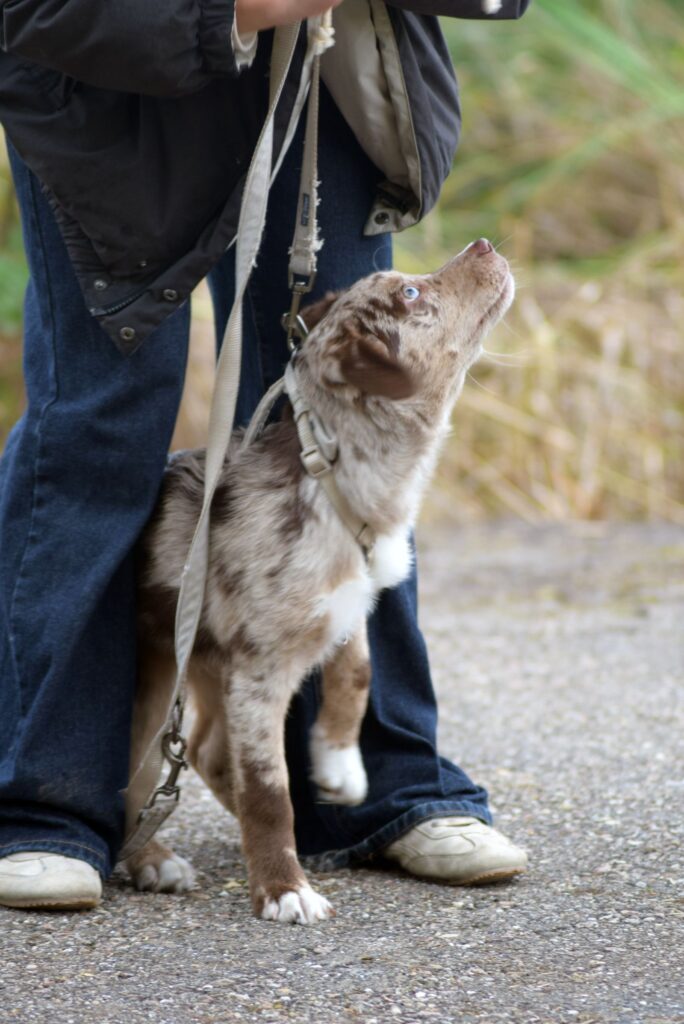
Puppies are the easiest to teach because they haven’t yet learned that pulling works. The AKC suggests starting leash skills as soon as your puppy comes home, even before vaccinations are complete, by getting them used to a harness and lead indoors and rewarding them for staying close. Keep sessions very short and fun, because puppy attention spans are short.
Adult and rescue dogs
An adult dog may have years of practice at pulling, so expect it to take longer. Rescue dogs also need time to settle before formal training; in our guide to the first three months with a rescue dog we explain why it is better to focus on safe, calm outings first and build up lead manners from around week three or four. Once your dog is walking well on lead, you can start working towards off-lead time with our recall training guide.
When to get a qualified trainer
Ask for professional help if your dog is too strong for you to hold safely, if pulling comes with lunging or growling, or if you have been consistent for several weeks without progress. Look for a trainer who uses reward-based methods. As the RSPCA notes, owners who choose reward-based trainers can be confident their dog won’t be subjected to painful equipment. Ask any trainer what they do when a dog pulls; if the answer involves corrections, check chains or prong collars, keep looking. If your dog suddenly starts pulling differently, or seems sore, a vet check is worth ruling out pain first.
Frequently asked questions
How long does it take to stop a dog pulling on the lead?
It varies with the dog’s age, history and how consistent you are. Short daily sessions and total consistency speed things up, while a long-established habit in an adult dog usually takes longer to change. Expect weeks rather than days.
Is a harness or collar better for a dog that pulls?
RSPCA Queensland recommends a well-fitted front-attaching harness for loose-lead training. A flat collar is still useful for ID tags.
Are no-pull head halters cruel?
Not inherently, but they need careful fitting and gradual introduction. RSPCA Queensland warns they can cause injury or discomfort if used inappropriately, so get advice before using one.
Are prong collars legal in Australia?
They are illegal to import, and their use is banned in Victoria, Tasmania and Queensland. The RSPCA and AVA recommend reward-based training instead.
Key takeaways
- Dogs pull because it works; stop when the lead goes tight and move when it is slack.
- Reward your dog often for being beside your leg, and use direction changes to keep them tuned in.
- Start somewhere quiet, then add distractions slowly.
- Use a well-fitted front-clip harness; avoid choke chains, prong collars and retractable leads.
- Keep sessions short and make sure everyone follows the same rules.
- Get a reward-based trainer if your dog is too strong, reactive or not improving.
Sources
- RSPCA Queensland: How can I stop my dog pulling on the lead?
- American Kennel Club: How to Teach a Puppy to Walk on a Leash
- RSPCA Knowledgebase: What is reward-based dog training and why does the RSPCA support it?
- RSPCA Knowledgebase: Are pronged collars harmful to my dog?
- RSPCA Knowledgebase: Are dog pronged collars illegal in Australia?
- Australian Veterinary Association: The use of punishment and negative reinforcement in dog training
- Purdue Canine Welfare Science: The Effects of Using Aversive Training Methods in Dogs, A Review (Ziv, 2017)
This article is general information only and is not a substitute for advice from a registered veterinarian or a qualified reward-based dog trainer. If your dog’s behaviour changes suddenly, or you think pain may be involved, talk to your vet.